
The Water of Life: Everything You Need to Know About Whiskey and drinking whiskey. From its 15th-century Scottish origins to the glass in your hand t
The Water of Life: Everything You Need to Know About Whiskey and drinking whiskey. From its 15th-century Scottish origins to the glass in your hand tonight
Whiskey is more than a drink. It’s centuries of craft compressed into a single pour. A spirit that has sealed business deals, toasted marriages, and warmed countless evenings around the world. Whether you’re completely new to it or looking to go deeper, here’s everything worth knowing.
Where it all began
The word whiskey translates from the Gaelic as uisce beatha — “water of life.” It originated in Scotland in the early 1400s, where distillers developed a spirit that balanced warmth, complexity, and character in a way nothing else quite matched.
Centuries later, that spirit has gone global. Scotland still holds its legendary status, but Japan, Australia, Ireland, the United States, and Canada all produce world-class whiskies with their own distinct identities. What’s remarkable is how faithfully modern distillers honour that original character.
The taste of whiskey today is remarkably close to what it was when first distilled all those years ago.
Whiskey vs. whisky: what’s the difference?
If you’ve browsed bottle labels and noticed both spellings, you’re not imagining things. The variation is regional, and both are correct depending on where the bottle was made.
Whisky: Scotland, Canada, Japan, Taiwan, Wales, and Australia.
Whiskey: Ireland and the United States.
The split dates back centuries. When aqua vitae was translated into Irish and Scottish Gaelic dialects, the spelling diverged slightly. Irish immigrants then carried the “e” to America in the 18th century, cementing the distinction that persists on labels to this day.
The three main styles
Whiskey is made from fermented grain mash — wheat, rye, corn, or barley — each lending its own character to the final spirit. Broadly, all whiskies fall into one of three styles.
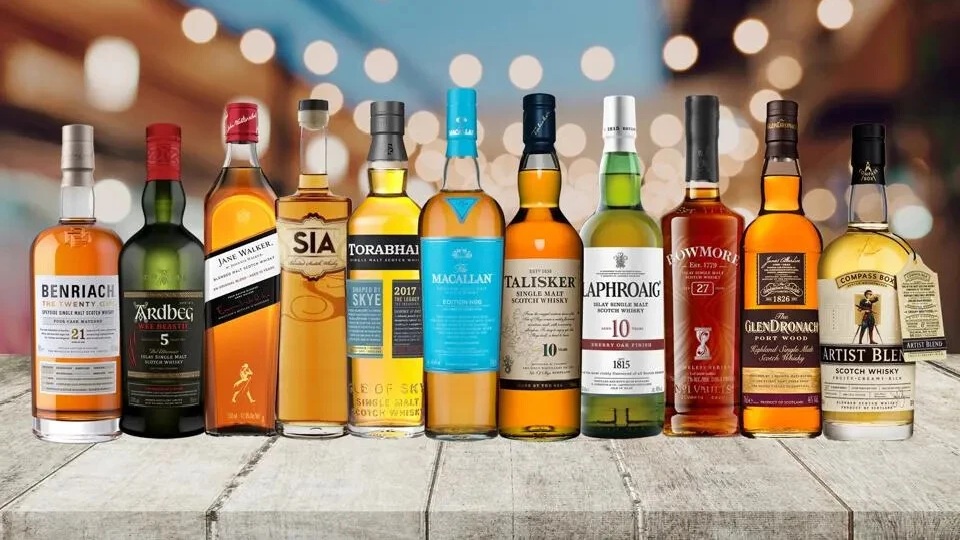
Single malt — Made at one distillery using only malted barley. It captures the unique character of its region and is considered the pinnacle by many connoisseurs. Scotland leads, but Japan and Australia are producing world-class versions.
Grain whiskey — Made from grains other than malted barley, such as corn, wheat, or rye. Bourbon must contain at least 51% corn; rye whiskey at least 51% rye. Most American whiskies fall into this category.
Blended — A mix of single malt (10–30%) and grain whiskey (70–90%). Often the best entry point — smooth, consistent, and accessible. Premium blends push the malt ratio higher for added depth and richness.
How whiskey is made
Making whiskey is as much art as science. Here’s how a spirit goes from raw grain to bottle:
Malting — Raw grain is soaked in warm water to trigger sprouting, then kiln-dried to stop germination.
Mashing — The malt is ground and mixed with water to release sugars, producing a liquid called wort.
Fermentation — Yeast is added to the wort, converting sugars into alcohol and creating a “wash.”
Distillation — The wash is run through stills to concentrate the alcohol and strip impurities.
Maturation — The spirit rests in oak barrels for years, developing its colour, flavour, and depth.
Bottling — Once matured, the whiskey is filtered, diluted to drinking strength if needed, and bottled.
The science of distillation
The type of still matters enormously. Single malts are usually distilled twice in copper pot stills, giving them a rich, oily texture. Irish whiskies are often distilled three times for a notably smoother finish. American grain whiskies typically use large column stills, which are more efficient and produce a lighter, cleaner spirit. The size and shape of the still shapes a whiskey’s character as much as the grain itself.
Peat, smoke, and chill filtration
Many Scotch whiskies owe their distinctive smoky character to peat. A fuel derived from compressed, decayed plant matter. When malt is dried over a peat fire, the smoke penetrates the grain and becomes part of the flavour. Most whiskies are also chill-filtered to prevent cloudiness when ice or water is added, though this can strip some of the natural oils. An increasing number of distilleries now offer non-chill-filtered expressions for those who prefer a richer, fuller mouthfeel.
Whiskies worth knowing
Scotland
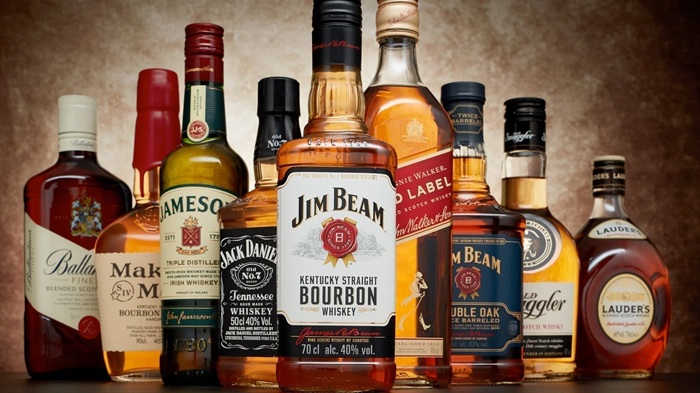
Scotland has more distilleries than any other nation, ranging across regions with dramatically different characters. Glenfiddich — Gaelic for “Valley of the Deer” — has operated in the Scottish Highlands since 1886 and remains one of the world’s most recognised single malts. Johnnie Walker, arguably the world’s best-known blended Scotch, runs from entry-level Red Label through to the exceptionally smooth Blue Label. Ballantine’s Scotch, distilled in Dumbarton, was a favourite of both Queen Victoria and King Edward.
Ireland
Irish whiskey is typically triple-distilled, giving it a softness that’s instantly recognisable. Jameson’s, established in Dublin in 1780, is the global standard-bearer. Tullamore Dew, founded in 1820, is a perennial favourite — particularly well-suited to Irish coffee.
America
American whiskey is dominated by bourbon and rye, with Jack Daniel’s and Wild Turkey among the most widely poured in bars and restaurants across the country. They’re drunk neat, on the rocks, or mixed with cola — all perfectly valid choices.
How to drink it
Here’s where things get personal. True connoisseurs will insist on drinking it straight. Just a slow sip to let the mellow tones open up. Others swear by “on the rocks,” where gradually melting ice softens the spirit’s bite and opens up different flavour notes. Some reach for a splash of water, which can unlock aroma compounds and open up the nose significantly.
And then there are cocktails, the Old Fashioned, the Whiskey Sour, the Manhattan. Where whiskey is the backbone around which everything else is built.
Whiskey has a remarkable knack for fitting every occasion. Many weddings choose it for the bridal toast precisely because of the symbolism: a spirit that has stood the test of time, just as the couple hopes to do. Business deals have been sealed over a dram, friendships deepened, and evenings made memorable by little more than a good bottle and good company.
From smoky Islay single malts to smooth Kentucky bourbons, whiskey is a spirit with something to offer everyone. The best place to start? Wherever your curiosity takes you.
While Scotland still holds the crown for world-class single malts, Japan and Australia are now producing highly acclaimed versions.
Grain Whiskey
Any whiskey made from grains other than malted barley—such as corn, wheat, or rye—is considered grain whiskey. Most American whiskies fall into this category. For example:
Bourbon must contain at least 51% corn.
Rye whiskey must contain at least 51% rye.
Blended Whiskey
Blends are often the gateway into whiskey. Known for their smooth, consistent taste, they are created by mixing 10–30% single malt with 70–90% grain whiskey.
Affordable blends lean heavily on grain whiskey, while premium blends boast higher percentages of malt for added depth and richness.
Whiskey vs. Whisky: What’s in a Name?
If you’ve browsed whiskey blogs or bottle labels, you’ve probably seen both spellings—whisky and whiskey. The difference is mostly regional:
- Whisky: Scotland, Canada, Japan, Taiwan, Wales, and Australia.
- Whiskey: Ireland and the United States.
The variation dates back centuries. The spirit was originally called aqua vitae (“water of life” in Latin). When translated into Irish and Scottish dialects, the spelling split slightly. Irish immigrants later carried the “e” spelling to America in the 18th century, cementing the distinction.
How Whiskey Is Made
The process of making whiskey is as much science as it is art. Here’s a simplified breakdown:
Malting – Raw grain is soaked in warm water to trigger sprouting, then dried in a kiln to stop germination.
Mashing – The malt is ground and mixed with water to release sugars, creating a liquid called wort.
Fermentation – Yeast is added to the wort, turning sugars into alcohol. The result is a “wash.”
Distillation – The wash is distilled in stills to concentrate the alcohol.
Maturation – The spirit is aged in oak barrels for years, developing flavor and complexity.
Bottling – Once matured, the whiskey is filtered, bottled, and ready for drinking.
Flavor Factors: What Shapes the Taste of Whiskey
Peat and Smoky Accents
Many Scotch whiskies owe their smoky character to peat. Which is a fuel made from decayed plant matter. When malt is dried over a peat fire, the smoke penetrates the grain, creating bold, earthy flavors.
Chill Filtration
Most whiskies are chill-filtered to prevent cloudiness when water or ice is added. However, this process can strip away some of the natural oils and flavors. Increasingly, distilleries are producing non-chill-filtered whiskies for those who prefer a richer, fuller taste.
The Science of Distillation
Distillation removes water and impurities, concentrating the alcohol.
- Single malt whiskies are usually distilled twice in copper pot stills, giving them a rich, oily texture.
- Irish whiskies are often distilled three times, resulting in a smoother finish.
- Grain whiskies and many American whiskies use large column stills, which are more efficient and produce a lighter texture.
The size and shape of the still also play a major role in determining a whiskey’s character.
The Final Word: It’s All About Taste
From smoky Islay single malts to smooth Kentucky bourbons, whiskey is a spirit that offers something for everyone. Whether you’re savoring a neat pour or mixing it into a cocktail, each sip tells a story of craftsmanship, tradition, and innovation.
So pour yourself a glass, explore different styles, and discover the world of whiskey one dram at a time.

COMMENTS