
Everyone has an opinion about whiskey. Ask anyone who drinks it seriously and they'll tell you — usually with conviction — that Scotland has the w
Everyone has an opinion about whiskey. Ask anyone who drinks it seriously and they’ll tell you — usually with conviction — that Scotland has the whole thing sorted. Single malts, blended Scotch, the romance of Highland distilleries and centuries of tradition. It’s a compelling argument and Scotland deserves every bit of its reputation.
But there’s another stable worth paying serious attention to. And it’s one that’s been quietly producing some of the world’s most interesting whiskey for over two hundred years.
Bourbon is America’s native spirit. Born in Kentucky, shaped by rebellion, and refined over generations into something that stands completely on its own terms — not as a lesser cousin of Scotch, but as a genuinely distinct and complex whiskey tradition that millions of people around the world have fallen in love with. If you’ve been sleeping on Bourbon because you assumed it was the rough, industrial relation of a proper single malt, it’s time to reconsider.
Where it all began — a Baptist minister and a happy accident
The story of Bourbon starts, as the best stories often do, with a person willing to try something different.
Elijah Craig was a Baptist minister in Georgetown, Kentucky in the late 18th century. The exact details of what he did and when have been disputed by historians for decades, but the legend — and it’s a good one — holds that Craig was among the first to age his whiskey in charred oak barrels, a process that transformed a harsh raw spirit into something smoother, richer, and altogether more interesting.
Whether Craig was the singular inventor of Bourbon or simply one of many distillers experimenting with the same techniques at the same time is almost beside the point. What matters is that Kentucky became the crucible in which American whiskey was transformed. The craft spread quickly. Farmers discovered that surplus corn could be profitably converted into whiskey. Neighbors shared techniques. Distilleries multiplied.
It’s even said that Thomas Lincoln. The father of Abraham Lincoln, was among those who got in on the action in its earliest days. Bourbon has always been a democratic spirit, as comfortable on a farm kitchen table as it is in a crystal glass at a formal dinner.
European roots and a spirit of rebellion
The knowledge that became Bourbon didn’t appear from nothing. European settlers arriving in North America brought distilling traditions with them — Scottish, Irish, and German immigrants all had experience with grain spirits — and shared those techniques with their new neighbours in the new world. The result was a boom in production unlike anything the continent had seen.
That boom didn’t go unnoticed by the government.
In 1791, the administration of George Washington imposed a tax on whiskey and whiskey sales — a move that became known as the Whiskey Rebellion. The distillers of Pennsylvania, who bore the brunt of the tax, were furious. Many refused to pay. Some were arrested. Washington eventually sent federal troops to suppress the rebellion in 1794, making it one of the first tests of federal authority under the new constitution.
For many distillers, the solution was simple. Move. Head deeper into the frontier, further from the tax collectors, into the Kentucky mountains where oversight was limited and limestone-filtered water — perfect for distilling — ran freely through the hills. That migration shaped the geography of American whiskey permanently. Today, eighty percent of all Bourbon produced in the world is distilled in the state of Kentucky.
The French connection — how Bourbon got its name
The name Bourbon itself carries a piece of history that most people who drink it don’t know about.
When the American colonies were fighting for independence from Britain, France provided crucial military and financial support. As a gesture of gratitude, new counties and settlements in America were frequently named in honour of French royalty and aristocracy. Bourbon County in Kentucky — named after the French royal House of Bourbon — was established in 1785, when Kentucky was still the Kentucky District of Virginia rather than an independent state.
The whiskey produced in and around Bourbon County was shipped down the Ohio River to New Orleans through the river ports of Kentucky, reaching a wide market across the growing nation. Barrels were often marked with their county of origin, Bourbon County, and the name stuck. What started as a geographic label became the defining name of an entire category of American spirit.
How Bourbon is made — and what makes it Bourbon
Unlike Scotch whisky, which is governed by centuries of Scottish law and custom, Bourbon is defined by a specific set of American federal regulations. These rules are what make Bourbon what it is — and without them, you’d just have American whiskey.
The mash must contain at least 51% corn. This is the fundamental requirement. The corn is what gives Bourbon its characteristic sweetness and soft texture — flavours that distinguish it immediately from the drier, more complex grain profiles of Scotch or Irish whiskey. The remaining grain bill — typically a combination of malted barley, rye, or wheat — contributes the secondary flavour notes that differentiate one Bourbon from another. High-rye Bourbons are spicier and drier. Wheated Bourbons (think Maker’s Mark or Pappy Van Winkle) are softer and rounder.
It must be distilled to no more than 160 proof (80% ABV) and entered into the barrel at no more than 125 proof (62.5% ABV). These limits preserve the character of the grain and prevent the spirit from being stripped of flavour by over-distillation.
It must be aged in new, charred oak containers. This is perhaps the single most important requirement — and the one that most distinguishes Bourbon from Scotch. Scotch can be aged in used barrels (often former Bourbon barrels, which is one of the reasons the two industries are so intertwined). Bourbon must go into new charred oak every time. The char acts as a filter and a flavour contributor simultaneously — it removes harsh compounds from the raw spirit while imparting vanilla, caramel, and wood notes that are synonymous with Bourbon’s character.
Straight Bourbon
The category most premium expressions fall into, must be aged for a minimum of two years. Most quality Bourbons are aged considerably longer. The angel’s share (the portion that evaporates through the barrel during ageing) can account for a significant percentage of the original volume, which is part of why aged Bourbon commands premium prices.
There is no requirement for Bourbon to be made in Kentucky — it can technically be produced anywhere in the United States. But the reality is that Kentucky’s climate, its limestone-filtered water, and its centuries of distilling tradition make it the undisputed home of the world’s best Bourbon.
What Bourbon actually tastes like
If you’ve only ever encountered Bourbon in a mixer or a mass-market cocktail, you may not have a complete picture of what it’s capable of.
At its best, Bourbon is a genuinely complex spirit. The corn contributes sweetness — caramel, vanilla, toffee. The oak adds structure, spice, and depth. The char brings a subtle smokiness that’s entirely different from the peated smoke of Islay Scotch, warmer, softer, more like toasted wood than burning peat. The specific grain bill of each distillery adds layers — baking spice from rye, soft bread from wheat, nuttiness from malted barley.
Drink it neat or with a single large ice cube that melts slowly. Take your time with it. The nose alone on a well-made Bourbon is worth the experience — pour it, let it breathe for a minute, then bring it slowly to your face and you’ll smell things you didn’t expect.
Bourbons worth trying
If you’re new to Bourbon or want to explore beyond what’s familiar, here’s a straightforward starting point:
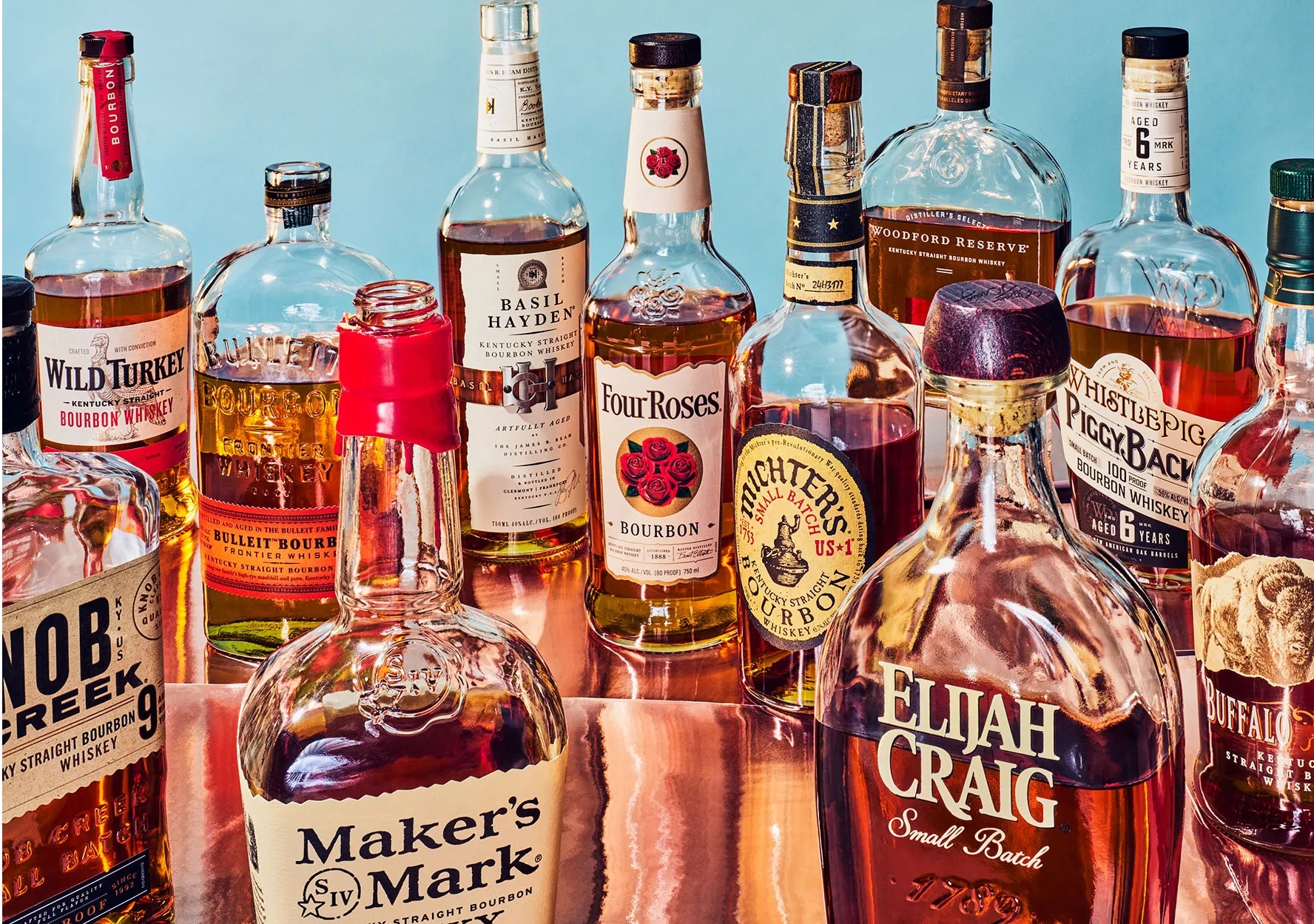
Elijah Craig Small Batch — named for the man who started it all. Rich, complex, with notes of vanilla, oak, and dark fruit. Excellent value for the quality on offer and a genuinely good introduction to what well-made Bourbon tastes like.
Maker’s Mark — a wheated Bourbon and one of the most approachable on the market. Soft, sweet, and smooth with a red wax seal that’s instantly recognisable. A reliable choice for anyone who finds high-rye Bourbons too sharp.
Woodford Reserve — a premium expression with a balanced grain bill and exceptional smoothness. Notes of dried fruit, vanilla, and a hint of chocolate. This is the Bourbon you reach for when you want to make an impression.
Buffalo Trace — consistently rated among the best value Bourbons in the world. Complex, well-structured, and widely available. If you only buy one bottle to start your Bourbon journey, make it this one.
Serve them in a proper whiskey glass. A Glencairn or a rocks glass with a large ice cube. It gives them the same attention you’d give a fine Scotch. They’ll reward it.
Bourbon in cocktails
Bourbon’s sweetness and body make it one of the most versatile cocktail bases in existence. It works in spirit-forward stirred cocktails as well as in longer shaken drinks.
The Old Fashioned is the classic Bourbon cocktail. A whiskey, a sugar cube, Angostura bitters, and a strip of orange peel, stirred over ice in a rocks glass. It’s one of the oldest cocktails in existence and one of the best. The Bourbon’s sweetness and the bitters’ complexity were made for each other.
The Whiskey Sour — Bourbon, fresh lemon juice, simple syrup, and optionally an egg white for foam. It shows off the spirit’s versatility in a completely different direction. Bright, refreshing, and balanced. A great entry point for anyone who finds neat Bourbon too intense.
The Manhattan uses Bourbon or rye with sweet vermouth and bitters. Richer and more complex than an Old Fashioned, and equally classic.
For more cocktail ideas head to our Whiskey Based Cocktails section.
You might also like
More from the Whiskey section: Whiskey 101: A Beginner’s Guide to the Water of Life Barbary Coast Cocktail It’s All a Whisky Business
From Best Gear and Guides: Best Cocktail Glasses Best Home Bar Setup Under $200 Best Jiggers for Your Home Bar

COMMENTS