
Twelve. Walk down the whisky aisle and that number is everywhere — Glenfiddich 12, The Glenlivet 12, Macallan 12, Balvenie 12. For a lot of people, tw
Twelve. Walk down the whisky aisle and that number is everywhere — Glenfiddich 12, The Glenlivet 12, Macallan 12, Balvenie 12. For a lot of people, twelve years has become a kind of shorthand for “proper” Scotch. So is it really the magic number? Is 12 year old scotch, really something ?
The short answer is that twelve years is a brilliant benchmark, but not for the reasons most people think. It is not the age at which whisky becomes “perfect,” and it does not mean that anything younger is inferior. What twelve years really gives you is a reliable, affordable sweet spot. Long enough in the cask to develop genuine depth and a smooth, rounded character, without the steep price of much older bottles.
Here is what the age actually tells you, why twelve became the standard, whether older is really better, and which 12-year-old Scotches are worth your money.
What the age statement on a bottle of Scotch actually means
First, a small but important correction to something you will hear often: Scotch is not “brewed.” Beer is brewed. Scotch whisky is made by fermenting malted barley, distilling the resulting liquid, and then maturing it in oak casks. That maturing stage, sitting quietly in wood for years, is where the age statement comes from.
By law, any whisky calling itself Scotch must be matured in oak casks in Scotland for at least three years. So even the youngest legal Scotch has had time in the wood. The number on the bottle goes a step further: an age statement tells you the age of the youngest whisky in that bottle. A “12 Year Old” means every drop inside has spent at least twelve years in the cask, even if some of it is older.
That last point matters. Distilleries often blend whiskies of different ages to get a consistent flavour, so they have to label the bottle with the youngest one. Twelve years is a promise about the minimum, not an average.
You will also see bottles with no age statement at all, labelled “NAS.” That does not automatically mean they are young or poor. Some excellent whiskies carry no age statement because the distiller has blended casks of different ages to chase a particular flavour rather than a particular number.
Why twelve years became the benchmark
So why does twelve, specifically, appear on so many flagship bottles?
It comes down to balance. In the first few years, a whisky takes on the basic influence of the cask, colour, some vanilla and oak. But it is over roughly the next decade that the more interesting things happen. The spirit softens, the rough edges round off, and deeper flavours develop: dried fruit, spice, honey, sometimes chocolate or smoke, depending on the cask and the distillery.
By around twelve years, most whiskies have reached a point where they taste mature, smooth and complete, with real character rather than raw spirit. They are no longer young and sharp, but they have not yet started to lose their own personality to the wood.
There is a practical reason too. The longer whisky sits in a cask, the more evaporates (distillers poetically call this the “angel’s share”), and the more a distillery has money tied up in stock it cannot sell. That makes older whisky genuinely scarcer and more expensive. Twelve years hits the point where the whisky is excellent and there is still enough of it to sell at a sensible price. That combination is exactly why distilleries anchor their core ranges at twelve.
Does older always mean better?
This is the part the “magic number” myth gets wrong. Older is not automatically better.
Up to a point, more time in the cask adds depth. But past that point you get diminishing returns, and eventually the oak can take over. A very old whisky can become drying, overly woody, or tannic, where the cask has overwhelmed the spirit. An 18 or 25 year old bottle can be sublime, but it can also simply be expensive, and not necessarily more enjoyable than a great 12.
Quality is about balance, not years. A well-made 12-year-old from a great distillery will beat a tired older bottle most days of the week. So treat the age as useful information, not a scorecard. The best whisky for you is the one whose flavour you enjoy, at a price you are happy to pay — and for a huge number of drinkers, that lands right around twelve years.
What twelve years does to the flavour
The cask does most of the work, and the type of cask matters as much as the time.
Most Scotch is matured in ex-bourbon barrels, which give vanilla, honey, light spice and a golden colour. Whisky matured or finished in ex-sherry casks picks up richer, darker notes: dried fruit, raisin, nutmeg, a deeper amber colour. Many 12-year-olds use a combination of both, which is why a Glenfiddich 12 (fresh, pear-like, lighter) tastes so different from an Aberlour 12 (rich, sherried, fruity), despite sharing the same age.
A good 12-year Scotch should feel smooth rather than harsh, with a warm, lingering finish. That warm glow as it goes down is the sign of a spirit that has had time to settle and integrate.
The best 12-year-old Scotches to try
These are our picks across the main styles, so you can choose by the flavour you are after. Whisky styles also vary by region, light and floral in the Lowlands, rich and fruity in Speyside, smoky and maritime on Islay. Our list spans the lot.
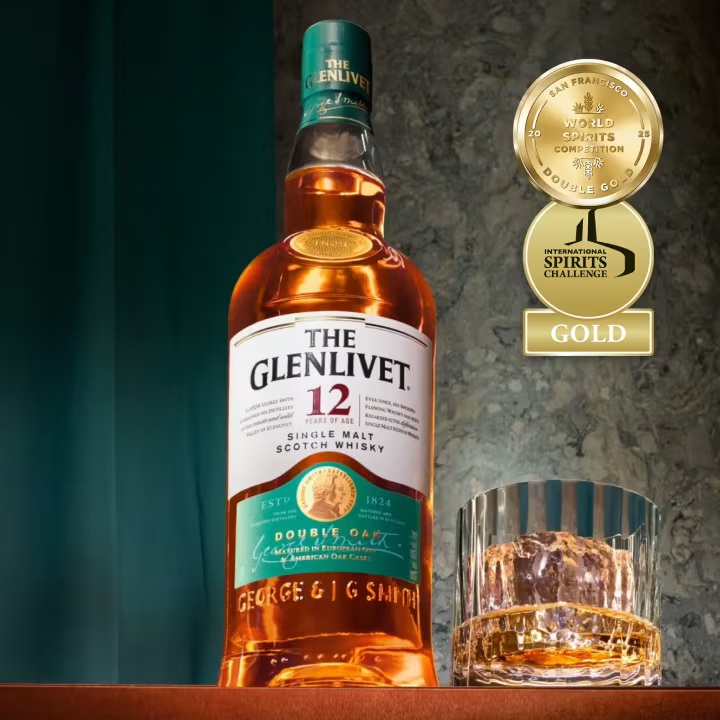
The Glenlivet 12 — best easy starting point. Smooth, light and approachable, with notes of apple, pear and a touch of honey. One of the best-selling single malts in the world for good reason, and an ideal first single malt.
Glenfiddich 12 — the global benchmark. Fresh and fruity with signature pear and oak. If you want to understand what a classic Speyside single malt tastes like, start here.
The Balvenie DoubleWood 12 — best honeyed all-rounder. Matured in bourbon casks and finished in sherry, giving honey and vanilla with a layer of dried fruit and spice. A crowd-pleaser that feels a step more luxurious.
Aberlour 12 — best for sherry lovers. Richer and fruitier, with raisin, toffee and warm spice from generous sherry-cask maturation. Lovely after dinner.
Highland Park 12 Viking Honour — best lightly smoky option. From Orkney, this balances heather honey sweetness with a gentle wisp of smoke. A brilliant bridge for anyone curious about peat but not ready for a full Islay bruiser.
Bowmore 12 — best smoky entry. A gentle, balanced Islay malt with soft smoke, sea salt and a little sweetness. The easiest way into peated whisky without being overwhelmed.
The Macallan Double Cask 12 — best premium pick. Rich, smooth and elegant, with sherry-driven dried fruit and vanilla. More expensive than the others, but a genuinely special bottle.
Chivas Regal 12 or Johnnie Walker Black Label — best blended option. If you prefer a smooth, easy-drinking blend over a single malt, these are the classic 12-year blended Scotches: balanced, versatile, and excellent value.
How to drink a 12-year-old Scotch
A good single malt deserves a little care, but you do not need to be precious about it.
- Neat first. Pour a measure and taste it as it is to get the full character.
- Add a few drops of water. A small splash, not a flood, opens up the aromas and softens the alcohol. Many experienced drinkers prefer their whisky with a little water.
- Use the right glass. A tulip-shaped glass like a Glencairn concentrates the aromas far better than a tumbler. It makes a real difference.
- Ice is your call. Purists avoid it because cold mutes the flavour, but if you enjoy it cold, use one large cube so it melts slowly rather than several small ones that water it down fast.
Sip slowly. A 12-year Scotch is built for savouring, not shooting.
Frequently asked questions
Is 12-year-old Scotch good? Yes. Twelve years is widely considered the sweet spot for single malt Scotch. Mature, smooth and full of character, at a price most people can justify. The flagship 12-year bottlings from the major distilleries are reliably excellent.
Does the age of Scotch matter? Age tells you the minimum time the whisky spent in the cask, which generally adds smoothness and depth. But older does not automatically mean better. Past a certain point the oak can dominate, and a great 12-year-old often beats a tired older bottle. Balance matters more than the number.
What does “12 years” mean on a bottle? It means the youngest whisky in the bottle has matured in oak casks for at least twelve years. Some of the whisky inside may be older, but none is younger.
What is the difference between single malt and blended Scotch? A single malt comes from one distillery and is made entirely from malted barley. A blended Scotch combines malt whisky with grain whisky, often from several distilleries, for a smoother, more consistent and usually more affordable result.
Is single malt better than blended? Not necessarily. Single malts tend to have more distinct character, but a good blend like Chivas 12 or Johnnie Walker Black is smooth, versatile and excellent. It comes down to taste, not status.
You might also like
- Bourbon In The Making
- Old Fashioned
- Manhattan
- 15 Tips For Making Cocktails At Home
- Easy 3-Ingredient Cocktails

COMMENTS